10 lessons from 10 years of QBayLogic
Reading time: 5 minutes
QBayLogic turns 10 this year. It started in 2016 as a two-person spin-off of the University of Twente, in Enschede, and it is now a team of engineers designing FPGAs and ASICs for clients who need fast, secure communication.
That’s worth celebrating, of course.
But it’s also a good moment to stop and reflect: what did we actually learn in these past 10 years?
When we asked the team, most answers had nothing to do with hardware. Nobody wrote about timing closure or formal proofs. The lessons are about people, luck, money… Across the board.
Here are ten of them.
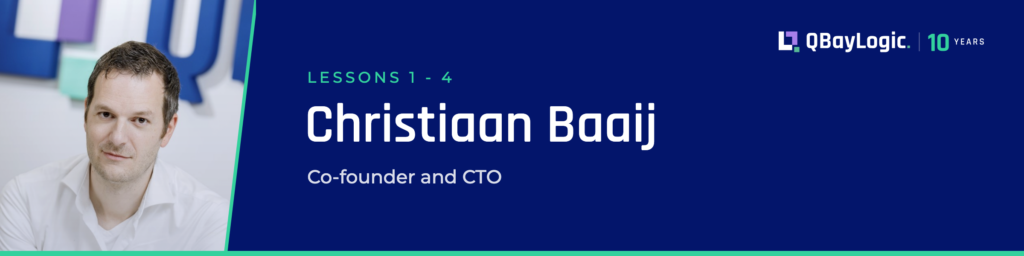
First, let’s hear from Christiaan Baaij (co-founder and CTO) who co-founded QBayLogic in 2016 and has been part of every stage since. His lessons come from that long view, and most of them are about the moment the technology stops being the problem.
Lesson 1: Projects fail for reasons outside the technology.
Projects fail even when the underlying technology is brilliant, because of all the peripheral issues around it.
Coming from the person whose work started with a compiler, this one is worth reading twice. Good technology is a requirement. Whether a project succeeds is usually decided by everything that surrounds it.
Lesson 2: People hire people they like.
You win projects because they like you, not because of a technically watertight story; the latter, however, is still a prerequisite.
The second half of the sentence matters as much as the first. A watertight technical story gets you to the table. What happens at the table depends on whether the client wants to work with you.
Lesson 3: Write the contract, even for a partner you know.
Always set up a contract and follow the quotation process, even when it’s a side job for an existing R&D partner. If you don’t, you might not get paid for your work.
The risk sits in the familiarity. With a new client, nobody skips the quotation. With a partner you already work with, a small extra job feels like a favour between colleagues, and that is usually when the paperwork gets left out.
Lesson 4: Put yourself where luck can find you.
Success is a matter of luck, so make sure you end up in situations where you can get lucky. That does take a lot of work, though.
It is an honest way to describe how a company gets started. The luck is real, and so is the work of being in the room when it arrives.
→ Next: Maarten!
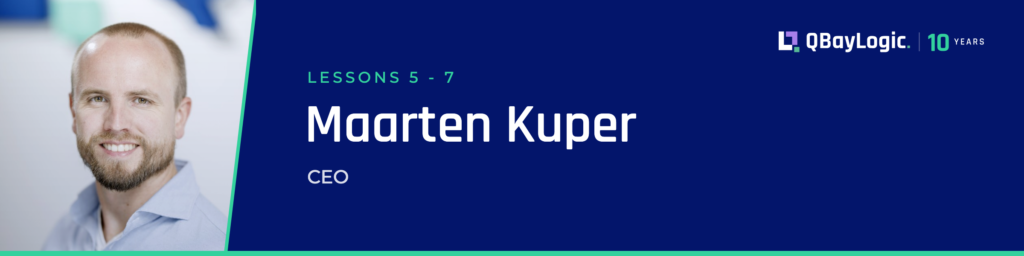
Maarten Kuper joined QBayLogic as CEO in 2022, into a company built by engineers. His lessons are the ones you only see from the commercial side, and two of them are mistakes he names plainly.
Lesson 5: A great product does not sell itself.
We underestimated the importance of sales and marketing. An engineering-driven company likes to believe a great product sells itself. It does not.
This one is easy to agree with and hard to act on. In a company of engineers, the design work always feels like the part that matters, and telling people about it feels like a distraction from it.
Lesson 6: Build the pipeline before you need it.
We allowed client concentration to reach over 60% of revenue, and only then started building the pipeline that should have prevented it.
This is probably the most uncomfortable lesson on the list, and that is why it is on the list. One large client is good news right up to the moment it is not. A sales pipeline takes far longer to build than that moment takes to arrive.
Lesson 7: Give looking after people its own job.
Bringing HR in-house was a good decision. Having someone whose job is to look after our people, rather than fitting it around everything else, helps our people-focused culture.
In a small company, HR tends to be something managers do in between other work. Making it someone’s actual job is a structural change, and it is the one decision on Maarten’s list that he names as a good one.
… and finally, what are the lessons of Martijn Bastiaan (COO)?
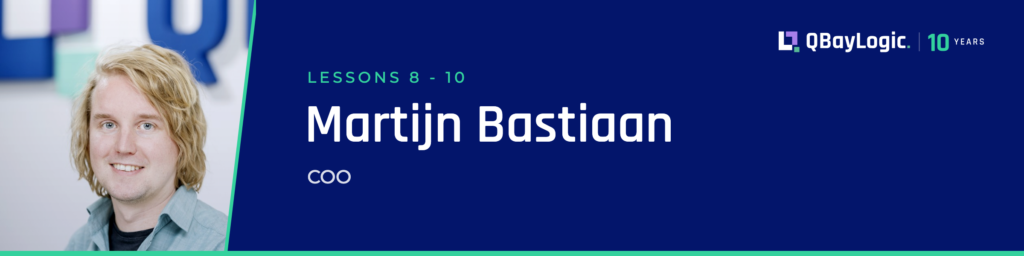
Martijn started at QBayLogic as a compiler engineer and is now COO. His lessons are about what holds a team together, and the last one could be a summary of his own path through the company.
Lesson 8: Feedback lands better than you fear.
Negative feedback can be very uncomfortable to give, but is virtually always picked up in a constructive manner.
The discomfort sits almost entirely with the person giving the feedback. That is useful to know the next time you are putting off a difficult conversation.
Lesson 9: Emotions are part of the business.
Emotions are a real part of business. You win contracts based on relationships. You keep the company together if you can create social cohesion.
Read this one next to lesson 2. Christiaan and Martijn wrote their lessons separately and arrived at the same conclusion about how work is won. Martijn adds the inside view: the same relationships that win contracts are what keep a team together.
Lesson 10: Learning fast beats knowing everything.
Technical expertise and experience are less important than an ability to obtain them.
From someone who went from compiler engineering to running operations, this is less of a theory than a description. In a field where the tools and the chips change every few years, what you know today has a short shelf life. How quickly you can learn the next thing lasts longer.
Note that these are ten lessons from one company of engineers in Enschede, written by three of the people who run it. They are not a management framework – each one comes from a specific situation in a specific company, and some of them may not hold in yours.
What stands out to us is how little of it is technical. After 10 years of designing FPGAs and ASICs, the engineering side is what we talk about most.
This time, we wanted to write down the other side.
Follow us on LinkedIn to learn more about what we’re up to.
FAQ
When was QBayLogic founded?
In 2016, as a two-person spin-off of the University of Twente in Enschede, the Netherlands.
What does QBayLogic do?
We design digital chips, FPGAs and ASICs, for clients who need high-speed, secure communication. Much of that work is built with Clash, the open-source compiler we maintain.