Clash is open source. For practical reasons, mainly
Reading time: 5 minutes
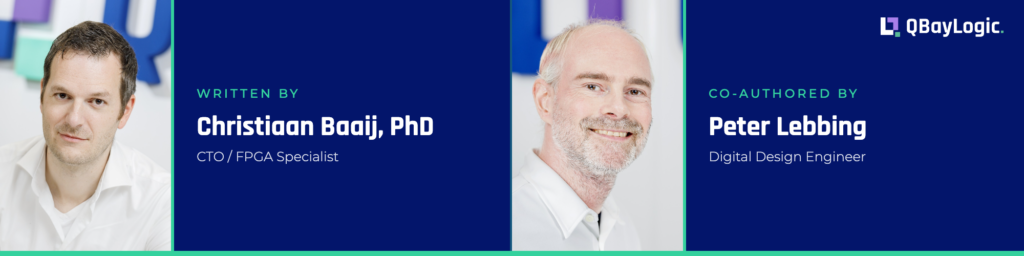
By Christiaan Baaij, PhD, CTO / FPGA Specialist, and Peter Lebbing, Digital Design Engineer.
Clash, the open source compiler that compiles Haskell to VHDL and Verilog, has been open source since it was first developed. So has nearly everything else we build for our own use. That is partly conviction: the origin story of QBayLogic revolves around scientific research, and we believe that knowledge grows best when it is shared. The decision to go open source has held for over a decade, because it is both the most practical and the most cost-effective way of maintaining and improving software.
We make our money doing hardware design and Clash is our tool. It’s one of the few open source EDA (Electronic Design Automation) tools available. With open source, we made the practical call: every hour we would spend on licensing and support tiers is an hour not spent on a customer’s design, and every barrier around the tool is a barrier for ourselves.
QBayLogic is not an open core company
When a commercial company uses or creates open source software, people usually want to know what the catch is. As far as we’re concerned, there isn’t one.
We are not an “open core” company. Open core, in the most common definition, means a liberally licensed core product, with paid extensions or paid support on top. We don’t do this. We design chips, we don’t sell software. There are no commercial extensions to Clash and there is no paid tier. Whether you’re a student, a scientist or a direct competitor: you can use the compiler, the libraries and the test infrastructure for anything, for free, without talking to us.
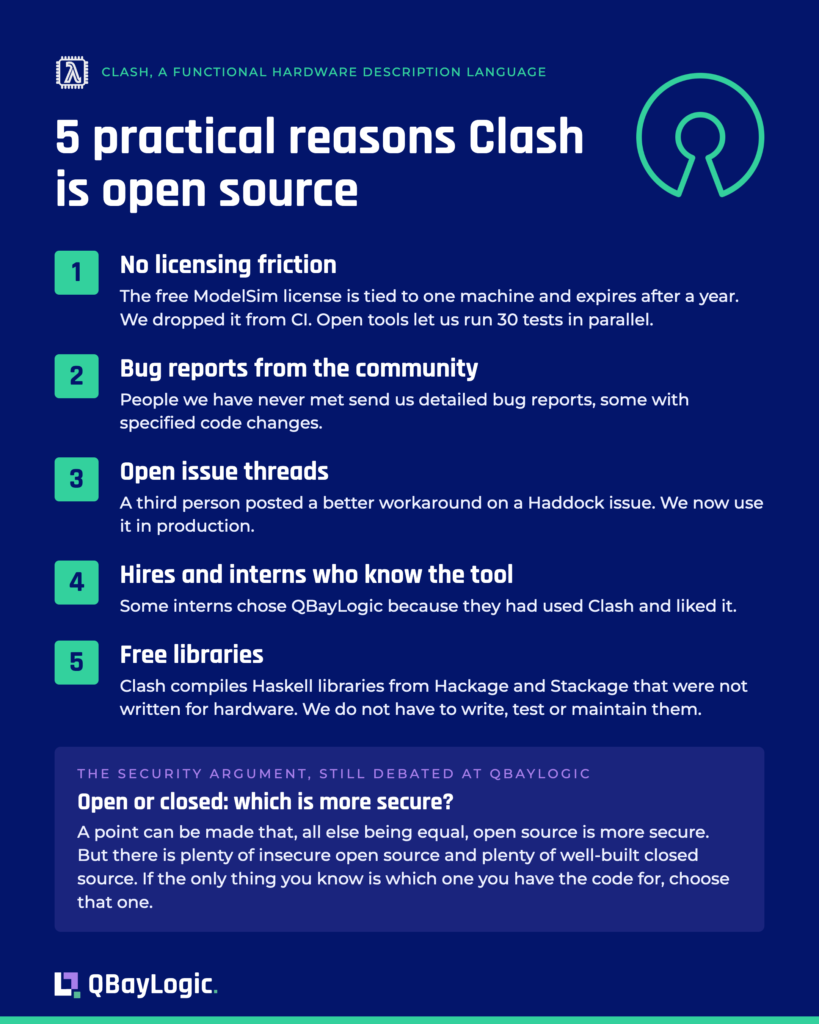
5 practical reasons we keep Clash open source, and the security argument we still debate.
What open source gives us in practice
Open source gives us 5 practical benefits:
- No licensing friction. Our continuous integration pipelines run the Clash test suite against several simulators. And although the suite supports ModelSim in all its variants, we don’t run ModelSim in CI because its free license is tied to a machine and expires after a year, so every runner needs a fresh license every year. That maintenance took more time than the job was worth, so we dropped it. Open tooling does not do this to you. We can run 30 tests in parallel without hitting a five-user cap. A university group can build, teach and research with Clash without buying anything. How this works for our customers is covered in Why we choose open source tooling (and when we don’t).
- Bug reports from the Clash community. We regularly get detailed bug reports from people we have never met, who put a lot of work into specifying code changes for us. With a small core team maintaining the compiler, these contributions make the difference between fixing a bug and leaving it on the backlog.
- Open issue threads. One of our compiler engineers filed a bug against Haddock, the open source Haskell documentation tool. Someone else had a related issue and posted a workaround. Later, a third person posted an even better workaround, which we now use in production. Anyone with the same issue can find the resolution online for free. This would not be possible in a closed-source environment.
- Hires and interns who already know the tool. We have had interns who chose QBayLogic because they had used Clash and liked it. They would not have done that if they’d had to pay for a license. Some students go further and study the source code to learn about hardware design in Haskell. Then, when they come to work for us, they already have a basic knowledge of Clash development.
- Free libraries. As an open source Haskell hardware compiler, Clash can compile Haskell libraries that were written with no thought of ever becoming hardware but now form the basis of many hardware designs. That only works because we have access to the source code. Hackage, the standard Haskell package repository, requires contributions to be open source. Stackage, an infrastructure project for Haskell that provides consistent, pre-tested sets of Haskell packages known as snapshots, sits on top of Hackage. This gives us many libraries we can use in hardware design without having to write, test or maintain them.
Open source and security
Admittedly, this is a topic of discussion within QBayLogic. But a point can be made that, all else being equal, open source software is more secure. Security researchers analyze open packages because they can. There are researchers who do not see any reason to contribute to a closed-source product. That said, there is plenty of insecure open source software, as well as plenty of well-built closed source tooling. But if the only thing you know about two programs is which one you have the code for, choose the one you can read.
Some things are closed, for good reason
Not everything we create can be open-sourced. Work we do for a client belongs to the client, and they decide. Most of our clients work in highly competitive or highly regulated fields, which usually means the code has to stay closed. That means you won’t find too many client designs on our GitHub. But Clash, its libraries and its test infrastructure are all there.
Clash, our Haskell to VHDL and Verilog compiler, has no paid extensions and no support tiers.
Frequently asked questions
Is QBayLogic an open core company?
No. There are no paid extensions or support tiers for the Clash compiler. Clash and all related tools and libraries are free to use for any purpose. QBayLogic earns money by designing and building hardware for customers, not from licensing software.
When is open source the pragmatic call?
Open sourcing your tool suite is a good idea when the tool is not what you sell. If your revenue comes from the work you do with the tool, every barrier around the tool is a barrier around your business, and licensing costs you more in friction than it earns.
What part of the source code does QBayLogic keep closed?
The only closed source code at QBayLogic is customer designs, and only when the customer wants them to be. Clash, its libraries and its test infrastructure are open source.
What advantages has open-sourcing Clash had for QBayLogic?
QBayLogic has benefited from the community around Clash in many different ways, the most important being bug reports from people outside the company, public issue threads that provide workarounds for known issues and easier sharing of knowledge, which has enabled new hires and interns to learn the Clash tool suite before joining, decreasing the time they needed to get up to speed.