
Clash Formal – Provable cybersecurity for Cyberagentur
Smart cards with mathematically proven security properties. Our Clash work for EvIT, Cyberagentur’s verification mission.

Terabit laser communication, first-pass correct
A 3µs deadline at 5000 fps, met on an FPGA. QBayLogic’s RTL design for TOmCAT, ESA’s Terabit Optical Communication Adaptive Terminal, delivered with TNO and Demcon.
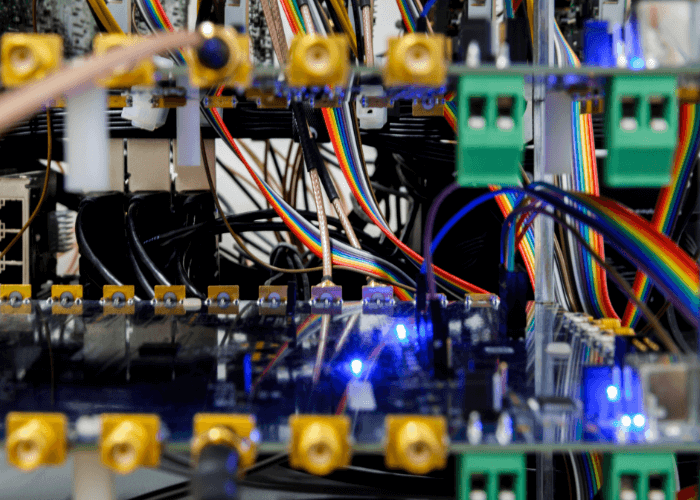

What we verified is what we shipped.
It all came together at delivery:

OUR CLIENTS



At QBayLogic, we specialize in designing FPGA architectures for accelerators using a model-based methodology. Our expertise made us the ideal partner to develop the Register-Transfer Level (RTL) design capable of processing high-bandwidth streams on an FPGA, a crucial component of the TOmCAT project. Our approach not only ensured timely delivery and last-but-not least also contributed to the advancement of ground/satellite communication technology.
For more information on the TOmCAT project, visit ESA’s website.
Applications where the applied expertise would also fit:

Smart cards with mathematically proven security properties. Our Clash work for EvIT, Cyberagentur’s verification mission.

Verification that catches problems early, not late. We rebuilt Axign’s flow around CI and simulation tooling for their next-gen audio chips.
Eight FPGA boards, optically linked, synced to the nanosecond. Our proof-of-concept hardware and software stack for Bittide, Google’s research ...