Choosing between FPGA, CPU, and GPU technologies for your project requires careful consideration of your specific needs. Each platform offers distinct advantages and trade-offs that make them suitable for different applications. Understanding these differences is crucial for making informed decisions about which technology best suits your particular requirements. Hence, this ‘FPGA vs. CPU vs. GPU’ shootout. Let’s go!
FPGA vs CPU vs GPU: Choosing the Right Computing Platform

First, it’s important to understand the core differences of these platforms:
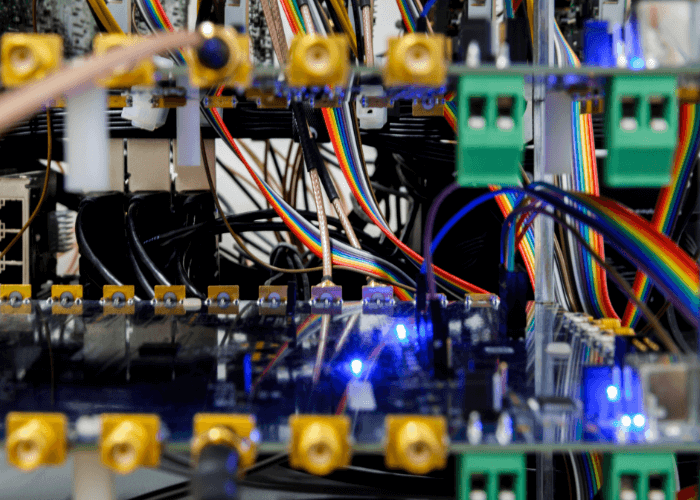
Field Programmable Gate Arrays (FPGA) represent a fundamentally different approach to computing by providing configurable hardware that can be customized for specific tasks. Unlike fixed-architecture processors, FPGAs consist of an array of programmable logic blocks with configurable interconnects. This unique architecture enables true parallel processing with customizable hardware paths, offering guaranteed response times and real-time performance capabilities that other platforms cannot match. FPGAs also provide exceptional flexibility in terms of power consumption and interface options, allowing designers to optimize their systems for extremely low power usage while supporting multiple custom interfaces for various sensors and devices.
The Central Processing Unit (CPU) serves as the general-purpose workhorse of computing, designed to handle a wide range of tasks through sequential processing. Based on the Von Neumann model, CPUs use a single memory bus for both instructions and data, which allows them to be highly versatile but can create bottlenecks in certain applications. They excel at executing varied instructions sequentially and can quickly switch between different tasks, making them ideal for general computing needs and operating system operations.

The Graphics Processing Unit (GPU) has evolved from being a specialized graphics processor into a powerful compute engine, particularly excelling at parallel processing of uniform calculations. GPU architecture is designed for handling massive amounts of similar calculations simultaneously, making GPUs highly efficient for specific types of workloads. However, they typically require significant power consumption with a minimum threshold of around 20 watts, and they have limited I/O options, primarily designed for memory bus connections. This makes them less flexible than FPGAs for certain applications, despite their impressive computational capabilities.
Choosing A Platform for Your Application
When selecting between these technologies, understanding their strengths in different scenarios is crucial. FPGAs shine in applications requiring predictable, real-time response at the nanosecond to microsecond level. Their ability to guarantee timing and maintain low latency while concurrently processing complex calculations makes them invaluable for critical systems. They’re particularly well-suited for embedded applications where power efficiency and multiple sensor interfaces are necessary.
GPUs, on the other hand, excel in scenarios requiring high throughput for uniform calculations across large datasets. They’re particularly effective for AI and deep learning applications, as well as some video processing tasks where exact timing isn’t critical. Their massive parallel processing capability makes them the go-to choice when raw computational power is the primary requirement and power consumption is less of a concern.
CPUs maintain their position as the most versatile option, ideal for general-purpose computing tasks. Their ability to handle varied instructions and quickly switch between different contexts makes them indispensable for most computing applications. They offer the most straightforward development environment and support for standard operating systems, making them the default choice for many applications.
CPU vs. GPU vs. FPGA: Making the Right Choice
The decision between GPU, FPGA and CPU often involves careful consideration of your application’s specific requirements. For time-critical applications where predictable, real-time response is crucial, FPGAs offer unmatched capabilities. Their ability to provide guaranteed timing and maintain complete control over the digital architecture makes them ideal for applications in automotive, aerospace, and industrial control systems.
When dealing with massive parallel processing needs, particularly for uniform calculations on large datasets, GPUs often provide the best solution. However, it’s important to note that achieving their theoretical maximum performance can be challenging, and their power requirements make them less suitable for power-constrained applications.
For general computing needs where flexibility and ease of development are paramount, CPUs remain the most practical choice. Their ability to handle diverse tasks efficiently, combined with extensive software support and development tools, makes them the foundation of most computing systems.