Preventing Technical Debt in Hardware Engineering
Reading time: 5 minutes
In software, technical debt is almost a cultural phenomenon. You hack a feature in under deadline pressure, promise yourself you’ll clean it up later, while “later” quietly never arrives. Most software teams carry some amount of technical debt, and many have learned to live with it. Managing it, occasionally paying it down, and treating it as an unavoidable cost of doing business.
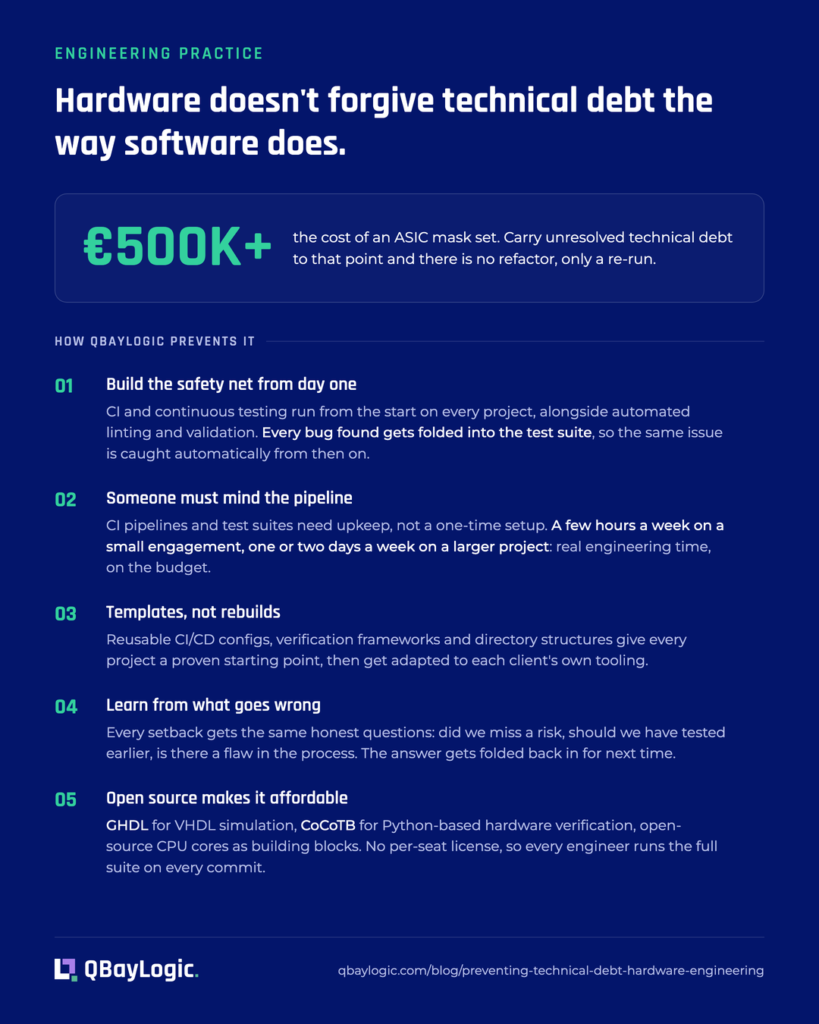
In hardware engineering, that approach doesn’t work. The costs of carrying technical debt into production are not gradual and manageable. They are sudden and severe. A mask set for an ASIC, the tooling required to manufacture a custom chip, costs half a million euros or more to make. If your design carries unresolved technical debt at that point, you don’t get a chance to refactor.
At QBayLogic, we design FPGA solutions, which are more forgiving than ASICs: you can update an FPGA after deployment. But the engineering mindset we bring to our projects comes from the same discipline. Preventing defects is the only responsible way to build hardware.
Building the safety net from day one
Our primary defense against technical debt is a rigorous, largely automated testing and integration infrastructure. Every project at QBayLogic runs continuous integration and continuous testing from the start. It’s part of how we set up a project.
Alongside CI/CT, we run automated linting checks and validation scripts in the background. The goal is straightforward: eliminate every category of preventable error before it has a chance to compound. When we do find a bug, and we always do, because complex systems produce them, we update the test suite so that the same issue is caught automatically from that point on. The safety net gets tighter with every project.
Someone must mind the pipeline
One thing that is easy to underestimate is the ongoing effort required to keep this infrastructure healthy. CI pipelines, test suites, linting configurations and build scripts are not set-and-forget systems. They need maintenance, updates, and improvements as the project evolves.
In practice, this means that every project team needs someone who takes responsibility for the engineering pipeline. How large that role is depends on the project: on a small engagement, it might be a few hours a week. On a larger project with multiple engineers, it can easily be one or two days a week.
This is real engineering time that appears on the project budget, and not every client immediately understands why it’s there. But the projects where this investment is made are the projects that succeed. The ones where it isn’t tend to accumulate exactly the kind of problems that cause delays and cost overruns later.
Templates and reuse
Not everything needs to be built from scratch for every project. We invest in reusable templates for project setup: CI/CD configurations, verification frameworks, directory structures, and standard tooling setups. One of our engineers has been developing a template project that provides a solid baseline for new engagements.
That said, every project has its own requirements. Templates get you started quickly, but they always need adaptation and restructuring to fit the specific context, adding project-specific checks, adjusting to the client’s tooling preferences. The value of a template is not that it eliminates setup work entirely, but that it ensures you start from a proven foundation rather than from zero.
Learning from what goes wrong
No process is perfect, and no project is free of surprises. What matters is what you do when things go wrong. At QBayLogic, a setback always triggers a set of honest questions:
- Did we miss an important risk?
- Should we have tested earlier or more thoroughly?
- Is there a flaw in our design process that we need to fix?
We take these questions seriously because we dislike repeating past mistakes. Sometimes the answer is yes, there was something we could have done better. That insight then gets folded into our processes for next time. But sometimes the honest answer is that the complexity simply came with the territory.
Complex technical projects with many stakeholders, many dependencies, and long timelines will always produce surprises. The discipline is in distinguishing between the surprises you could have prevented and the ones you couldn’t and being rigorous about addressing the former.
Open source makes it possible
A practical enabler of our approach is open-source tooling. We use tools like GHDL for VHDL simulation, CoCoTB for Python-based hardware verification, and open-source CPU cores as building blocks in our designs. These tools make it possible to implement comprehensive testing and integration practices without the prohibitive license costs of proprietary alternatives.
That’s a practical choice. When your verification framework doesn’t require a per-seat license, you can afford to run it on every commit. When your simulation tool is freely available, every engineer on the team can use it without budget negotiations.
Open-source tooling lowers the barrier to doing things properly.
And in hardware engineering, doing things properly is not optional.
Frequently asked questions about preventing technical debt in hardware engineering
Why is technical debt more serious in hardware than in software?
Because the costs are sudden and severe rather than gradual. A mask set for an ASIC, the tooling required to manufacture a custom chip, costs half a million euros or more, and a design that carries unresolved technical debt at that point gets no chance to be refactored. FPGAs are more forgiving, since they can be updated after deployment, but the same engineering discipline applies.
How much project time does maintaining a CI pipeline cost?
On a small engagement it can be a few hours a week. On a larger project with multiple engineers, easily one or two days a week. CI pipelines, test suites, linting configurations and build scripts are not set-and-forget systems, so every project team needs someone who takes responsibility for the engineering pipeline. This is real engineering time that appears on the project budget.
Which open-source tools make rigorous hardware testing affordable?
GHDL for VHDL simulation, CoCoTB for Python-based hardware verification, and open-source CPU cores as building blocks in designs. The practical benefit is economic as well as practical: when a verification framework does not require a per-seat licence you can afford to run it on every commit, and when a simulation tool is freely available every engineer can use it without budget negotiations. This improves the quality of the end product.